Headless Development WordPress to Headless Migration
Headless Development WordPress to Headless Migration
Keep WordPress as your content engine. Strip away everything that slows it down. We migrate your site to a decoupled architecture — blazing-fast frontend, full editorial freedom, no compromises.
What This Service Covers Full migration from monolithic WordPress to a headless stack
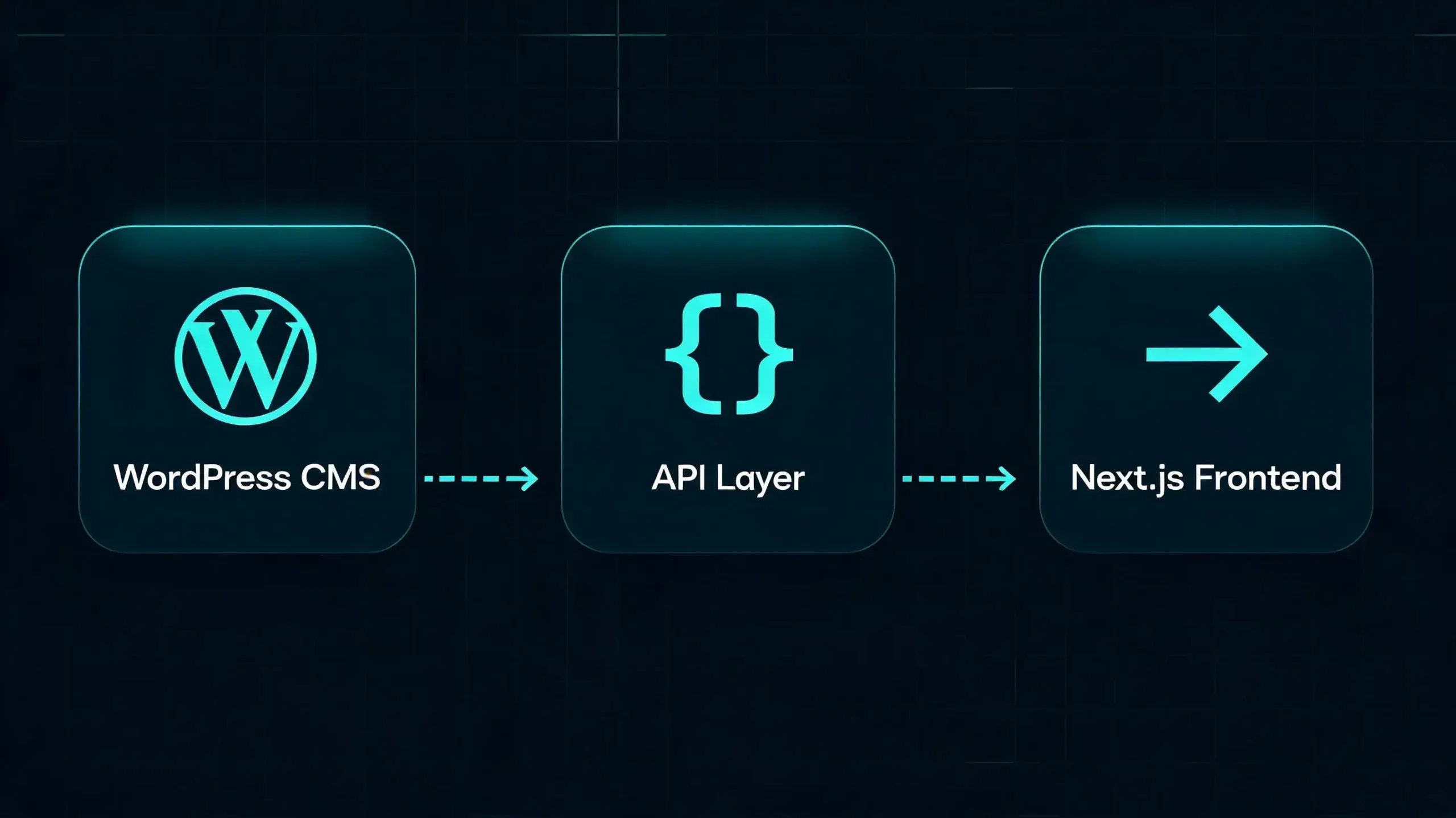
We audit your existing WordPress site, redesign the data architecture, and build a blazing-fast decoupled frontend — all while keeping the CMS your editors already know. You get the best of both worlds: a familiar WordPress backend with a modern, performant frontend powered by Next.js.
WordPress as a Pure API Backend
Your WordPress installation keeps everything that already works — your content, your SEO equity, your editorial workflows — while we replace the slow part: the frontend. We expose your content through the WP REST API or WPGraphQL and build an independent Next.js frontend on top, delivering sub-second load times and 95+ Core Web Vitals scores.
Your editors never leave the WordPress admin. Your developers never fight a theme again. The migration is handled in phases so your live site stays up throughout, and we preserve all existing URL structures, redirects, and metadata to protect your organic search rankings from day one.
Data Architecture & Content Modelling
Before a single line of frontend code is written, we audit your existing post types, taxonomies, and custom fields. We restructure your content model using ACF Pro or native Custom Post Types to ensure every piece of data is clean, typed, and queryable — whether you choose REST or GraphQL as your API layer.
A well-designed content model means your editors work faster, your API responses are leaner, and your frontend components stay simple. We document the full schema so your team can extend it confidently long after launch.
Next.js Frontend — Fast by Default
We build your new frontend with the Next.js App Router, using static generation for marketing pages and server components for dynamic content. Pages that used to score 45 on PageSpeed routinely hit 95–100 after migration. Every route is optimised for Core Web Vitals: LCP, INP, and CLS are treated as first-class requirements, not afterthoughts.
The frontend is fully decoupled — you can redeploy it, redesign it, or swap it out entirely without touching WordPress. Your content layer and your presentation layer are finally independent of each other.
SEO, Redirects & Zero Downtime Launch
Headless migrations fail when SEO is treated as a post-launch task. We map every existing URL before we write a single route, implement 301 redirects for any structural changes, and carry over all meta titles, descriptions, canonical tags, Open Graph data, and structured schema from your existing site.
Launch day uses a blue-green deployment strategy — your old site stays live until the new one is verified and passing all checks. Your rankings are protected, your users see no interruption, and your team signs off before anything goes public.
Why Migrate? Why move away from traditional WordPress?
Traditional WordPress couples your content with its delivery layer — PHP templates, page builders, and a plugin ecosystem that slows your site to a crawl under load. A headless approach decouples the two: WordPress manages your content; a modern JavaScript frontend delivers it at edge speed.
The result? Sub-second page loads, unlimited frontend freedom, superior Core Web Vitals scores, and a content editing experience your team already knows.

OUR TECHNOLOGY STACK Built on modern, open-source frameworks.




What’s included in every migration
We don’t do partial migrations. Every project follows our full four-phase methodology.
Discovery & Architecture Audit
We analyse your existing WordPress structure — plugins, custom post types, ACF fields, media, and third-party integrations. We document every data dependency and design the new headless schema before writing a single line of frontend code.
Custom Frameworks
Beyond Next.js and Nuxt — we build headless frontends on Astro, SvelteKit, and Remix for teams with specific performance or DX requirements.
Headless eCommerce
Decouple your WooCommerce or Shopify store. Custom cart, checkout, and product pages on a performant frontend — with full editorial control.
CMS Integrations
Connect your headless frontend to any CMS — Contentful, Sanity, Storyblok, or keep WordPress. We architect multi-source content strategies.
Progressive Web Apps
Turn your headless site into a full PWA — offline support, install prompts, push notifications, and app-like performance on any device.
Launch, SEO & Handover
We handle DNS cutover, redirect mapping (301s), XML sitemap resubmission, and Core Web Vitals verification post-launch. Your team gets documentation and a training session so they’re fully independent from day one.
What you gain after migration
Headless WordPress sites consistently outperform their monolithic counterparts on every measurable metric:
- 60–90% faster TTFB — pages served from CDN edge, not PHP
- Core Web Vitals: all green — LCP under 1.5s is standard
- Zero plugin conflicts — frontend is completely decoupled
- Infinite scalability — traffic spikes don’t hit WordPress
- Better DX — TypeScript, component libraries, hot reload

Frequently asked questions
Everything you need to know about migrating your WordPress site to a headless architecture.
Yes — absolutely. One of the core goals of a WordPress headless migration is to preserve the editorial experience. Your content team continues working in the WordPress admin, Gutenberg, or ACF field groups exactly as before. The only thing that changes is what delivers that content to visitors.
A typical WordPress-to-headless migration for a brochure or service site takes 4–10 weeks depending on content complexity, number of custom post types, and third-party integrations (e.g. WooCommerce, booking systems, CRMs). We provide a detailed timeline estimate after the discovery audit.
When done correctly, SEO improves significantly after a headless migration. We handle full redirect mapping, canonical URLs, XML sitemap regeneration, structured data (Schema.org), and Open Graph tags on the new frontend. Core Web Vitals improvements alone provide a meaningful ranking uplift. We also resubmit your sitemap and monitor Search Console for 2–4 weeks post-launch.
WooCommerce headless migrations are a specialised track within this service. The WooCommerce REST API or WPGraphQL for WooCommerce can expose product data, cart, and checkout to a custom frontend. We build the full cart and checkout experience in the frontend framework of choice. Learn more about our headless WooCommerce service.
For most WordPress migrations we recommend Next.js — it has the most mature WordPress integration ecosystem (WPGraphQL + Apollo, or REST + fetch), built-in ISR for semi-static pages, and a large community. Nuxt is our recommendation for teams already working in Vue. Astro is ideal for content-heavy, low-interactivity sites where maximum performance is the priority.
Yes. WordPress Multisite to headless is a more complex project — each subsite becomes its own data source, and we architect a multi-tenant frontend strategy (subdomain routing, shared components, per-site theming). We’ve done this for multilingual networks and multi-brand setups. Contact us to discuss your specific setup.
Related articles & resources
 Headless Architecture
Rebuilding Restrictive Webflow and Shopify Sites into Managed CMS Masterpiecese
The Proprietary Trap: When SaaS Builders Become Profit Cages It usually begins as an efficient shortcut. When launching a new digital store or enterprise web presence, all-in-one SaaS platform builders like Shopify or visual design spaces like Webflow seem like the perfect answer. They promise zero-code environments, quick template setups, and managed hosting options that ...
 Mobile App Dev
Bridging the Web App Gap: Converting Your Website into Native iOS and Android Apps
The Mobile Dilemma: Responsive Web vs. True Native Performance Almost every business recognizes that mobile devices drive the vast majority of their digital traffic. For years, the standard remedy was simple: make your website responsive. Ensure that grid layouts stack vertically, navigation links scale down for touch controls, and images shrink appropriately for smaller screens. ...
 Headless Architecture
Beyond the Monolith: Why It’s Time to Take Your WordPress Headless
The Architecture Bottleneck: Why Traditional WordPress Is Stalling Your Growth Every scaling digital business eventually hits the WordPress wall. It starts innocently: you build a custom site, install a few plugins for SEO, a couple more for marketing automation, and an optimization layer to help manage caching. But over time, the monolithic architecture of traditional ...